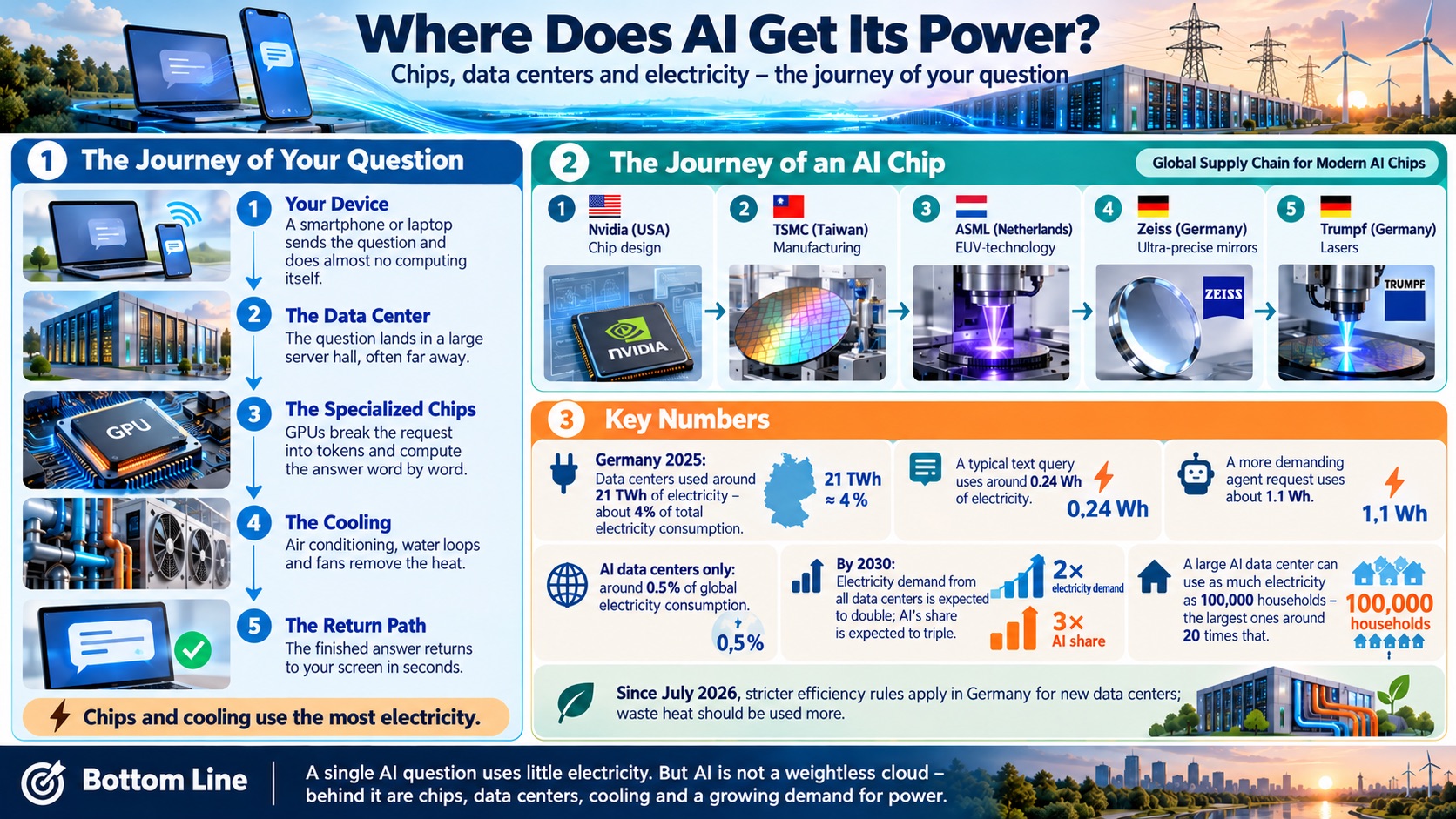
You type in a question, and a few seconds later the answer appears. It feels easy, almost weightless. Yet somewhere in the world, at this very moment, thousands of specialized chips are running hot, fans are roaring and cooling water is flowing. This article follows your question on its journey and shows what AI needs in terms of technology and electricity.
A note up front: the figures come from freely accessible sources, above all the International Energy Agency (IEA) and the providers themselves. Measurements of the electricity used by individual requests are still new and vary depending on the model and method. They should therefore be read as an order of magnitude, not as exact values.
Your Question’s Journey at a Glance
Before we go into detail, here are the stations a single question passes through:
- Your device: Your smartphone or laptop sends your question off over the internet. Your device itself does hardly any of the calculating.
- The data center: The question lands in a huge hall full of servers, often hundreds or thousands of kilometers away.
- The specialized chips: There, graphics processors (GPUs¹) break your question down into tokens² and calculate the answer word by word.
- The cooling: The chips get hot in the process. Air conditioning, water circuits and fans carry the heat away.
- The way back: The finished answer travels back to your screen, usually within a few seconds.
Each of these stations needs electricity. But the chips and their cooling need the most.
Why Graphics Cards, of All Things?
A normal processor (CPU) is an all-rounder: it handles many different tasks one after another, very quickly and flexibly. A neural network, however, needs something else. It has to carry out millions of simple calculations at the same time, mostly basic multiplications and additions.
That is exactly what graphics cards are good at. They were originally built for video games, to calculate millions of pixels in parallel. In 2012, researchers around Geoffrey Hinton trained the image recognition network “AlexNet” on two ordinary gaming graphics cards – and clearly beat all their competitors. This moment is considered the starting signal of deep learning. How it came about is told in the article “From Dead End to Breakthrough: The Wild History of Artificial Intelligence”.
Today’s specialized AI chips have little in common with gaming graphics cards anymore. They are bigger, more expensive and tuned for exactly this kind of computing work. But the principle has stayed the same: many small computing units working at the same time. And the more of them are running, the more electricity flows.
A Chip’s Journey: From California via Taiwan to Swabia
To understand where the computing power comes from, it’s worth following a single AI chip on its journey. It begins in California, at the company Nvidia. That’s where engineers design the chip – they draw up the blueprint, so to speak. Today, Nvidia designs most of the AI chips running in the world’s data centers. Google, Amazon and other companies now also develop their own chips to become less dependent.
But there is one thing Nvidia doesn’t have: a factory of its own. So the blueprint travels on to Taiwan, to the contract manufacturer TSMC. That’s where the vast majority of the world’s most advanced chips are made, in clean rooms that are cleaner than any operating room.
In these factories stands a very special machine. It “exposes” the tiny structures onto the chip, much like a photo used to be exposed onto photo paper. Because the structures are so unimaginably small, this requires extreme ultraviolet light (EUV³). Only one company in the world builds these machines, each the size of a bus: ASML from the Netherlands.
And now it gets surprisingly German. EUV light can’t be steered through glass lenses – it would simply be swallowed. You need mirrors, and the smoothest in the world at that. They come exclusively from Zeiss in Oberkochen, in the German state of Baden-Württemberg. A comparison shows how smooth they are: if you blew one of these mirrors up to the size of Germany, its highest bump would be just a tenth of a millimeter. The light itself is produced by a laser from Trumpf in Ditzingen near Stuttgart. For this technology, researchers from Zeiss, Trumpf and the Fraunhofer Institute received the German Future Prize (Deutscher Zukunftspreis) in 2020.
So the next time you ask an AI a question, there’s probably a little piece of Swabia in it.
A Visit to the Data Center
Imagine a hall as big as several football fields, without windows, well guarded. Inside, cabinets full of computers stand in long rows, little lights blink, and it’s as loud as a factory floor. That’s a data center – and this is where your question lands.
The astonishing thing: almost every kilowatt hour of electricity that flows into this hall ends up as heat. The chips work like small hotplates. That’s why a data center needs electricity not just for computing, but also plenty of electricity to cool itself. In the past, large air-conditioning systems were enough. But today’s AI chips sit so close together and get so hot that air alone is no longer sufficient. More and more often, cooling water flows through fine pipes directly past the chips, similar to the water cooling in a car.
How economically a data center uses its electricity is revealed by a figure called PUE⁴. Put simply, it shows how much electricity is used on top of the actual computing, for example for cooling. In Germany, this value is already fairly good on average.
And how much do data centers in Germany use? In 2025, it was around 21 terawatt hours⁵ of electricity – about four percent of all the electricity Germany consumes. A particularly important location is Frankfurt am Main, because many of Europe’s major internet lines converge there.
What Does a Question Actually Cost?
For a long time, people could only guess. Now there are real measurements – and they are surprising. In 2025, Google calculated that a typical text question to its AI Gemini uses around 0.24 watt hours of electricity. That’s roughly as much as your TV uses in nine seconds. Or as much as a microwave uses in a single second.
Things look different when the AI is supposed to do more than just answer. If you let it “think” longer or, as an agent⁶, complete several steps on its own – such as searching the internet, comparing results and writing a summary – it computes much longer. The International Energy Agency estimates such a request at around 1.1 watt hours, a good four times as much. Even more electricity flows when the AI paints pictures or even generates videos.
For a single question, all of this is very little. But every day, hundreds of millions of people ask their questions. Many small drops add up to a whole stream – of electricity, quite literally.
And then there is something that doesn’t appear in these figures at all: training⁷. Before an AI can answer its very first question, thousands of chips compute for weeks or months to let it learn from huge amounts of text. This feat happens once, but it is then part of every later answer.
The Big Picture: How Hungry Is AI Really?
Let’s zoom out now and look at the whole world. In 2025, all data centers together used roughly as much electricity as Germany generates in a year. That sounds enormous. However, they run far more than just AI: your streaming evening, your emails, your online banking and every website you visit also come from such halls. If you count only the data centers built specifically for AI, you arrive at about half a percent of the world’s electricity.
But the direction is clear. The electricity demand of AI data centers grew by half in 2025 alone. The International Energy Agency expects the consumption of all data centers to double again by 2030 – and the share of AI within it to triple.
The real problem is often not the global total, but the concentration in individual places. A single large AI data center uses as much electricity as 100,000 households – the largest ones currently under construction, even twenty times as much. If several of them are built in one region, the local power grids quickly reach their limits.
Becoming More Efficient – a Race
There is good news, too. Every single AI answer is becoming more economical at a breathtaking pace. Google reports that in May 2025 a typical text request used only one thirty-third of the electricity it needed a year earlier. The International Energy Agency speaks of efficiency gains never seen before in the history of energy. Behind this are better chips, smarter and smaller models, and data centers that distribute their work more cleverly.
The catch: because AI keeps getting cheaper and better, more and more people use it – and for more and more demanding tasks. What is saved on each question is immediately eaten up again by growth. It’s a bit like more fuel-efficient cars that people then simply drive more.
In Germany, lawmakers have therefore set rules. Since July 2026, new data centers have had to operate particularly efficiently. They are also expected not to simply blow their waste heat into the air, but to gradually make a growing share of it usable, for example to heat homes via district heating networks. It’s not quite that simple, though: this only works where such networks are nearby.
What Remains
A single text question to an AI today uses less electricity than a few seconds of television. So there’s no need for a guilty conscience with every question. Still, AI is not a weightless miracle from the “cloud”, but hard technology: chips from a worldwide supply chain, halls full of servers and a growing hunger for electricity. How an answer emerges from all this computing work in the first place is explained in the article “What Does AI Actually Do When You Ask It a Question?”.
For everyday life, this means: a simple mode is usually enough for a simple question. Elaborate agents, images and videos are worthwhile where they really bring a benefit.
The exciting question is not whether AI needs electricity – every technology does. The exciting question is whether its benefits ultimately outweigh its consumption. And all of us do a small part of that calculation with every request.
Glossary: Key Terms Explained Simply
¹ GPU (graphics processing unit) – Originally developed for video game graphics. Can carry out a great many simple calculations at the same time, which makes it ideal for neural networks.
² Token – A building block of text into which AI models break down language. Can be a whole word, part of a word or a single character.
³ EUV lithography – A process in which tiny chip structures are transferred onto silicon wafers using extreme ultraviolet light. The most advanced chips cannot be made without EUV.
⁴ PUE (Power Usage Effectiveness) – A measure of a data center’s efficiency: total electricity consumption divided by the consumption of the computers. 1.0 would be ideal; 1.2 means that for every 100 kilowatt hours used for computing, another 20 go to cooling and other equipment.
⁵ Terawatt hour (TWh) – One billion kilowatt hours. For comparison: a normal household uses a few thousand kilowatt hours a year.
⁶ AI agent – An AI that doesn’t just answer but completes several steps on its own, such as searching the internet, editing files or operating programs.
⁷ Training – The phase in which an AI model learns from huge amounts of data. It takes place once before release and is especially demanding in computing power and electricity.