Imagine reading a headline in the New York Times in 1958: a new machine will soon walk, talk, see, write, and be conscious of its own existence. Sounds like 2024, right? But it's actually 66 years older. The history of AI isn't a straight line of progress — it's a roller coaster of euphoria, disillusionment, and surprising comebacks. And that's exactly what makes it so worth reading.
A note up front: the following facts, figures, and examples come from freely accessible sources on the internet — scientific papers, archival material, specialist articles, and historical overviews. The central events and dates are well documented, though in some places (such as exact budget figures or the precise wording of historical quotes) sources vary slightly. Where figures differ, the most common or a conservative estimate was chosen.
The Journey at a Glance
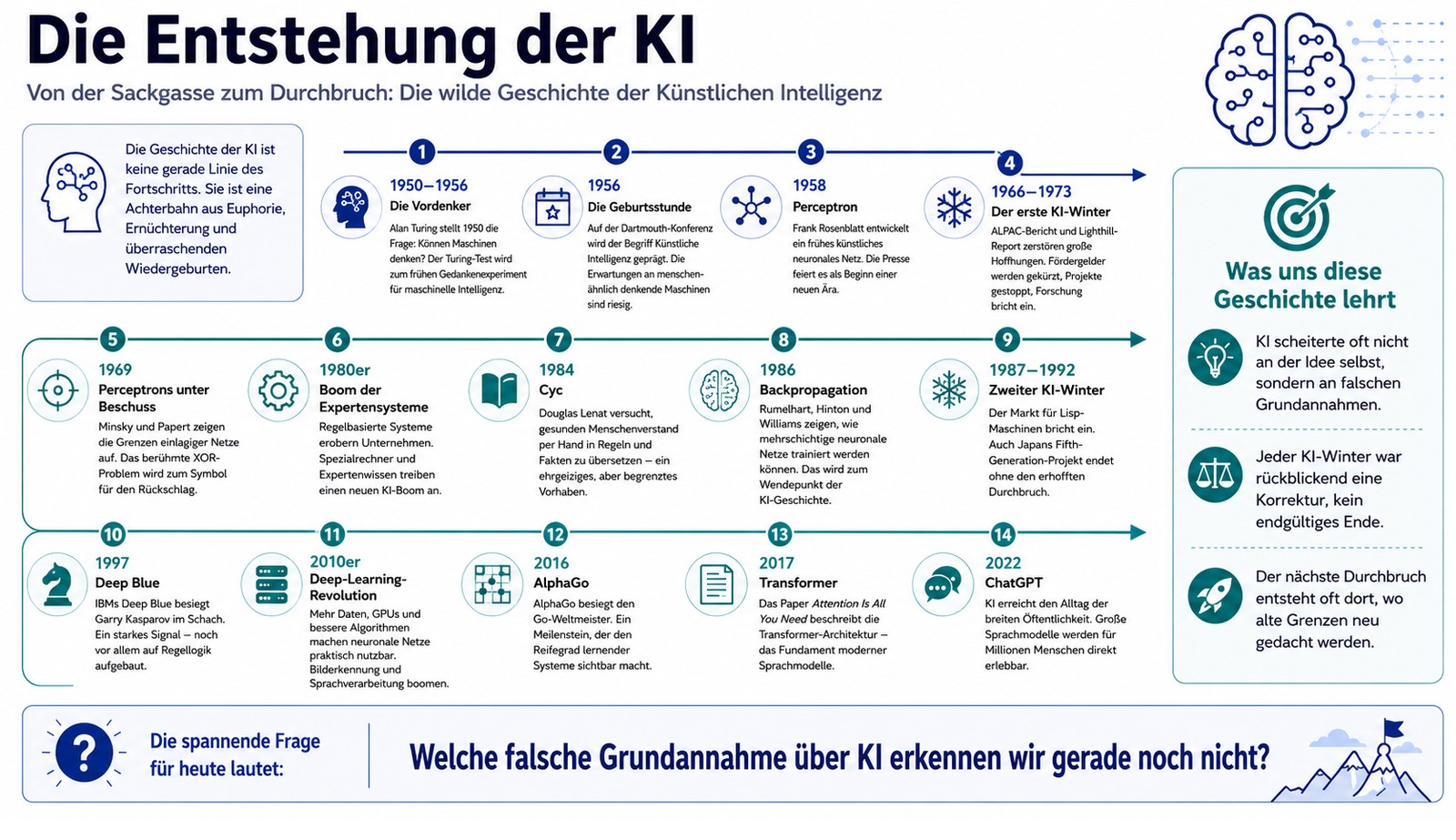
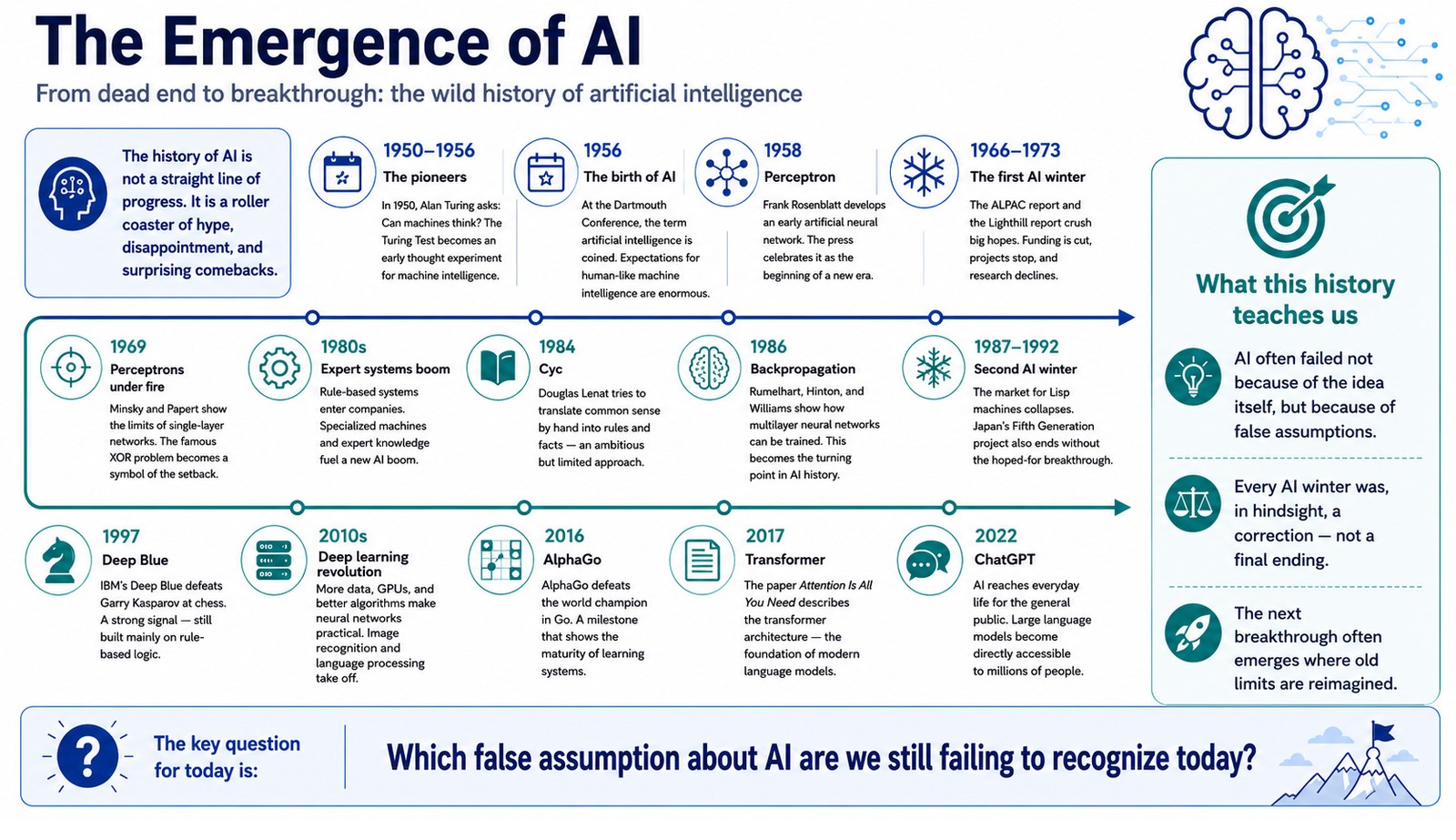
Before we dive deep, it's worth looking at the big picture first — the key milestones at a glance:
- 1950–1956 – The Pioneers: In 1950, Alan Turing asks the question “Can machines think?” and provides an early thought experiment with the Turing Test¹.
- 1956 – The Birth of AI: At the Dartmouth Conference, the term “artificial intelligence” is coined. The official starting point of the research field, with enormous expectations of human-like machine intelligence arriving soon.
- 1970s – The First AI Winter: Ambitious promises go unfulfilled, computing power falls short, and funding is cut.
- 1980s – Expert Systems: A second boom driven by rule-based systems in businesses, for example for medical diagnoses. Ends once again in a collapse (second AI winter, late 1980s).
- 1990s–2000s – Machine Learning Takes Center Stage: Instead of rigid rules, systems increasingly rely on learning from data (machine learning²). In 1997, Deep Blue defeats chess world champion Kasparov.
- 2010s – The Deep Learning³ Revolution: More computing power (GPUs⁴), massive amounts of data, and better algorithms (neural networks) bring the breakthrough: image recognition, language processing, and in 2016 AlphaGo defeats the Go world champion.
- Since ~2018/2020 – The Era of Large Language Models: The Transformer architecture⁵ (2017), GPT models, ChatGPT (2022) — AI arrives in the everyday life of the general public instead of existing only within expert circles.
That's the map. Now let's get to the actual story behind it — with all its dead ends, failures, and surprising turning points.
A Summer When It All Began
1956, Dartmouth College, USA. A handful of scientists — including John McCarthy and Marvin Minsky — meet for an entire summer to discuss “thinking machines.” This is where the term we read everywhere today is coined for the first time: artificial intelligence. The mood is euphoric. It’s assumed that machines will be able to think like humans within a generation.
Six years later, Frank Rosenblatt builds the “Perceptron⁶” — a simple artificial neural network⁷ that can learn to recognize patterns. The press goes wild. The Navy funds the project, hoping for self-learning war machines. It feels like the beginning of a new era.
The First Setback: A Book Brings Everything to a Halt
In 1969, something happens that nearly ends the entire research direction. Marvin Minsky himself — one of AI’s founding fathers — publishes a book together with Seymour Papert, simply titled “Perceptrons.” With clean mathematical rigor, they prove that these simple networks can’t even solve simple logical tasks. One particular problem — known today as the XOR problem⁸ — is unsolvable for them.
The impact is devastating. Funding for neural networks dries up almost overnight. For nearly 15 years, hardly anyone dares to research in this area. A single book had frozen an entire research field.
At almost the same time, but independently, another great dream collapses: machine translation. After the Sputnik shock, the US had invested millions to automatically translate Russian texts into English — they wanted to know what the Soviets were doing. In 1966, the sobering ALPAC report arrives: machine translations are slower, more expensive, and worse than a human's. Here too: money gone, project dead.
Britain doubles down in 1973. A government report by Sir James Lighthill declares nearly all of AI research a failure. The consequence: almost all British universities halt their AI research. The first “AI winter⁹” has arrived — a time when the words “artificial intelligence” become almost toxic in funding applications.
The 80s: A New Spring — and an Even Harsher Winter
But science rarely dies for good. In the 1980s, a new idea emerges: instead of letting machines learn on their own, they’re fed expert knowledge in the form of rigid rules. These “expert systems¹⁰” boom. Companies build special computers — so-called Lisp machines — just to run these systems. A billion-dollar market emerges practically out of nowhere.
And then, in 1987, this market collapses almost overnight. The rules were too rigid, too expensive to maintain — every new rule could throw ten old ones into disarray. At the same time, ordinary PCs keep getting more powerful and cheaper. Why buy an expensive specialized machine? The second AI winter begins.
At the same time in Japan, a gigantic project called the “Fifth Generation Computer” is underway — over 400 million dollars in government funding flows into the plan to build a completely new generation of computers with built-in logic. Ten years later, in 1992, the project is quietly ended. The ambitious goals were never achieved.
Another project from this era deserves special mention because it continues to this day, yet never fulfilled its original promise: Cyc. Since 1984, Douglas Lenat has been trying to program common sense into a machine — by hand, fact by fact, rule by rule. Millions of entries later, it becomes clear: the approach hits an invisible wall. You can't type in the world's complexity by hand.
The Turning Point: An Old Algorithm Is Rediscovered
And then, in 1986, the actual turning point of the whole story happens — almost unnoticed by the public. Researchers David Rumelhart, Geoffrey Hinton, and Ronald Williams show that the 1969 problem only applied to single-layer neural networks. By stacking multiple layers and using a trick called backpropagation¹¹ to send the error back through the network, problems that previously seemed impossible suddenly resolve themselves.
So Minsky and Papert's death sentence for the perceptron wasn't a fundamental verdict on neural networks — it only applied to an overly simple version of them. This insight provides the blueprint for everything that follows.
Still, it takes decades before this idea can unfold its full power. Two things are missing: enough data and enough computing power. In 1997, IBM's Deep Blue defeats chess world champion Garry Kasparov — an important signal, but still built on pure rule-based logic, not on learning.
The Explosion: When Everything Suddenly Came Together
Starting in the 2010s, everything changes. Graphics cards (originally built for video games) turn out to be ideal for performing the massive calculations required by neural networks. The internet delivers gigantic amounts of training data. And the old 1986 backpropagation idea suddenly unfolds its full effect.
In 2016, AlphaGo defeats the world champion in the board game Go — a game considered so complex that experts had expected this moment only decades later. In 2017, a scientific paper appears with the unassuming title “Attention Is All You Need” — it describes the so-called Transformer architecture, the technical foundation on which practically every modern language model is built.
And then, in 2022, AI leaves the world of experts on a large scale for the first time and arrives in the everyday life of millions of people: ChatGPT is released. What began in 1956 as a bold vision during one summer in Dartmouth, what nearly died twice, what fell into obscurity for decades — is suddenly part of everyday normal life.
What This History Teaches Us
What’s fascinating about all these failed projects: almost always, the real mistake wasn’t in the idea of “artificial intelligence” itself, but in an overly narrow assumption about how it had to be built. Single-layer instead of multi-layer networks. Hand-written rules instead of learning from data. Symbolic logic instead of scaling.
In hindsight, every “AI winter” was less an ending than a painful correction of a false underlying assumption — often a shift from symbolic AI¹² toward data-driven learning. And every comeback began with concrete, verifiable proof that this correction actually works — backpropagation, statistical translation, GPU-accelerated deep learning.
A good reminder for us today: the current AI boom, too, will eventually hit its own limits. The interesting question isn't whether that will happen — but which false underlying assumption we haven't yet recognized.
Glossary: Key Terms Explained Simply
¹ Turing Test – A test proposed by Alan Turing in 1950: if a human can no longer tell, in conversation, whether they’re communicating with a machine or a person, the machine is considered to be “thinking.”
² Machine Learning (ML) – The umbrella term for methods in which a computer isn't programmed with fixed rules but instead independently recognizes patterns from example data and derives predictions from them.
³ Deep Learning – A subfield of machine learning based on especially many stacked layers (“deep” neural networks). Enables the recognition of very complex patterns, such as in images or language.
⁴ GPU (Graphics Processing Unit) – Originally developed for computing video game graphics. Turns out to be ideal for the massive, parallel calculations that neural networks require — and is what makes modern AI practically usable in the first place.
⁵ Transformer Architecture – A technical concept introduced in 2017 that allows models to especially well capture the relationship between words far apart in a text. Forms the technical foundation of all modern language models such as ChatGPT or Claude.
⁶ Perceptron – One of the very first artificial neural networks, developed in the 1950s/60s. A very simple model that roughly mimics how a single nerve cell in the brain processes signals.
⁷ Neural Network – A computer model loosely modeled on how the human brain works. Consists of many simple, interconnected computing units (“neurons”) that together learn to recognize patterns.
⁸ XOR Problem – A simple logical task (“either-or, but not both”) that a single-layer perceptron cannot solve mathematically. Became a symbol for the limits of early neural networks.
⁹ AI Winter – Term for phases in which funding, public interest, and expectations for AI research collapse sharply, usually because previously raised expectations weren't met.
¹⁰ Expert System – An AI approach from the 1980s: instead of learning from data, the knowledge of human experts is entered into the system by hand in the form of fixed “if-then” rules.
¹¹ Backpropagation – A mathematical method by which a neural network learns from its mistakes: the error at the end of the calculation is sent backward through the network to improve each individual connection by a small amount.
¹² Symbolic AI – An older AI approach in which knowledge is represented as explicit symbols and logic rules (e.g., “a bird can fly, unless it’s a penguin”). Stands in contrast to today’s data-driven learning.