You type in a question. A few seconds later, an answer appears — fluent, often surprisingly accurate. But what actually happens in that brief moment?
The short answer: no thinking in the human sense. Instead, pattern recognition, probability, and a whole lot of mathematics that ends up feeling like understanding.
Let's take it apart.
The Journey From Your Question to the Answer
1. Your Text Gets Broken Down
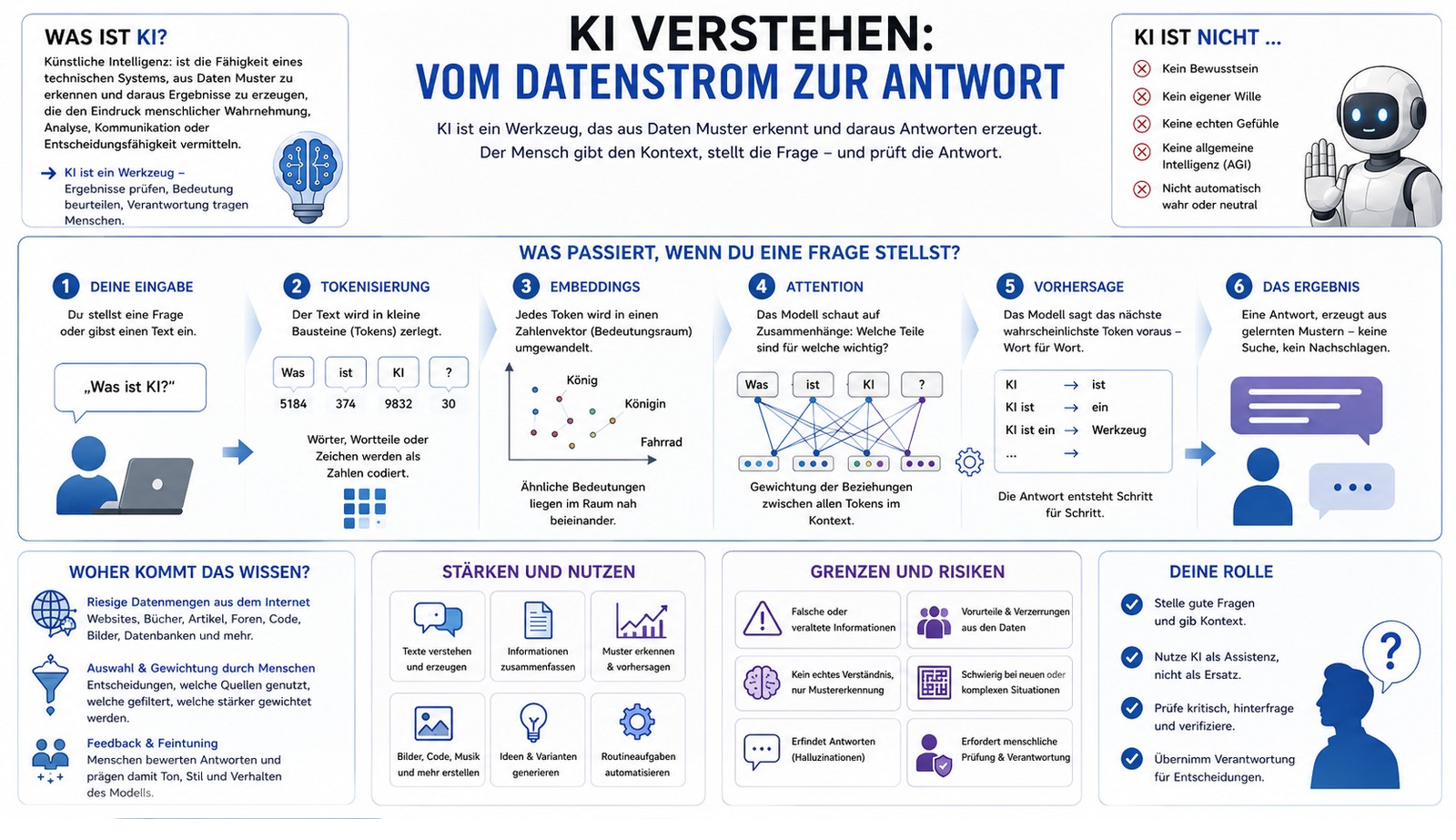
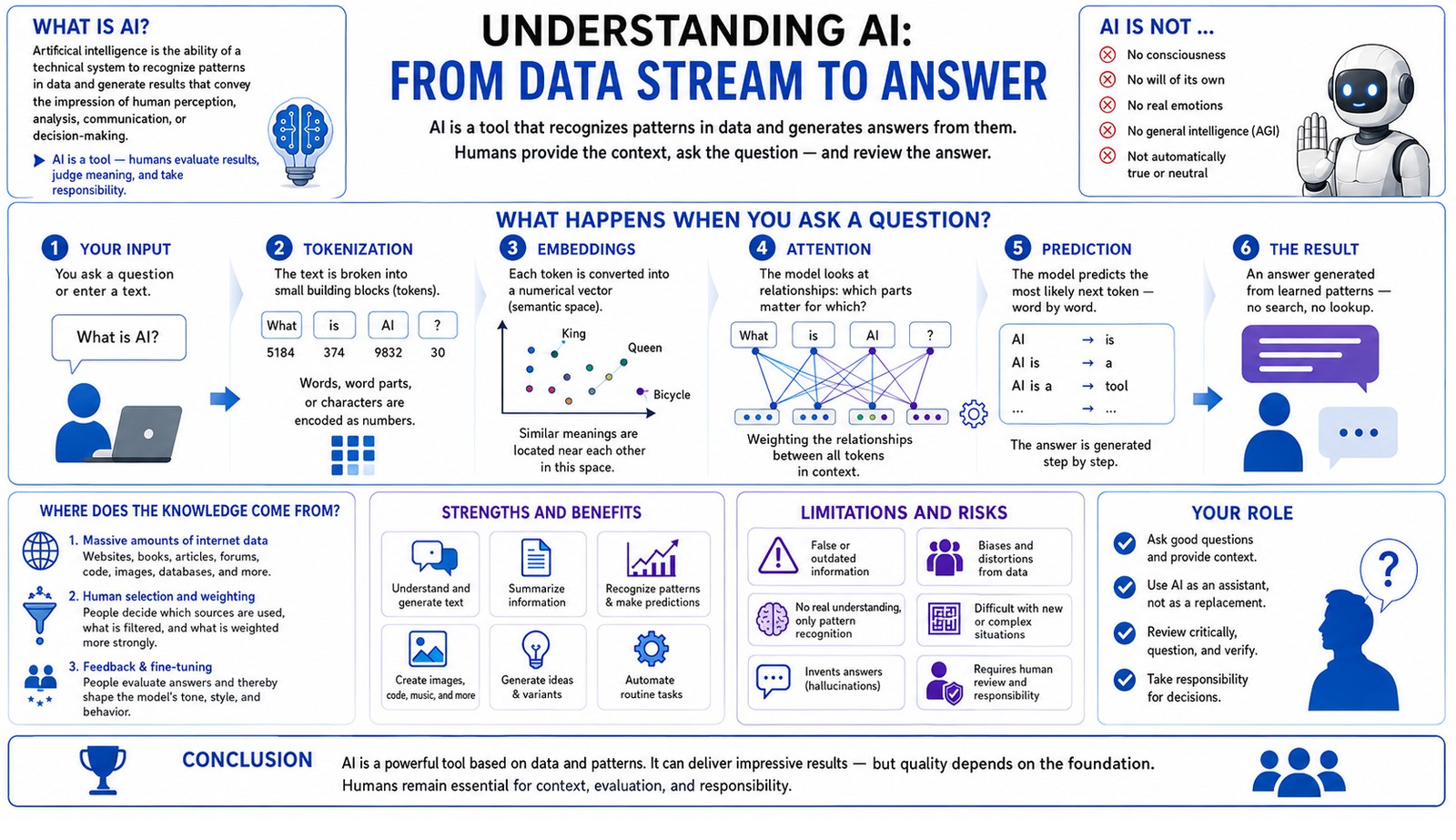
First, your input isn’t read as a “sentence” — it’s chopped into small building blocks called tokens¹. These can be whole words, but often just parts of words. Each of these blocks becomes a number.
2. Numbers Become Meaning
Each token ends up as a vector² in a vast “meaning space” — a long list of numbers describing a position. Similar terms end up close together there. “king” and “queen” are closer to each other than “king” and “bicycle.”
3. Attention³: The Model Looks at Relationships
This is where the real trick of modern AI happens. For every word, the model calculates how strongly it relates to every other word in the sentence.
Here’s an example: “The bank by the river was wet.” Without context, “bank” is ambiguous — a financial institution or a riverbank? The model weighs the words in the sentence against each other, and “river” ends up carrying a lot of weight. That strong connection tips the meaning of “bank” toward the riverbank. This doesn’t happen just once, but across many layers stacked on top of each other — with each layer, the meaning becomes more precise.
4. Prediction Instead of Thinking
In the end, the model calculates: which next word is most likely? The answer emerges piece by piece, each time based on everything that came before.
5. Not a Lookup — a Distillate
Important to understand: an AI doesn't search a database for the right answer. The knowledge is distributed across billions of numerical values created during training — more like an extremely compressed statistical distillate of text than a library of index cards.
The More Important Part: How Was the AI Trained?
The process above explains the how of a single answer. But the truly decisive question is a different one: what was the model fed before it could even answer at all?
Because this is exactly where the imprint comes from that every AI answer carries with it.
Layer 1 – The Training Data Itself
The base training happens with massive amounts of text from the internet: Wikipedia, forums, news sites, books, code. Whatever biases exist on the web end up in the model too. Overrepresented languages, overrepresented perspectives, outdated facts, unnoticed prejudices.
Layer 2 – Selecting and Weighting the Data
This is where people come in. Companies decide which sources are included and which are filtered out, which languages or topic areas are weighted more heavily. That's already a value judgment — even when it's justified with good intentions like quality or safety.
Layer 3 – Fine-Tuning⁴ Through Human Feedback
After the base training, people rate answers as good or bad, and the model is trained to produce more of the “good” ones. This is where the views of the raters flow in directly: what counts as helpful? What counts as appropriate? What tone is desired?
The consequence: There is no neutral AI. Every model carries an imprint — through the data selection, through the people who rated it, through the culture of the company behind it. That's exactly why ChatGPT, Claude, or Gemini sometimes answer differently on politically or culturally charged questions.
Where Pattern Recognition Hits Its Limits
A few examples make it tangible where this isn't actually real understanding:
Counting letters: The question “How many letters does ‘strawberry’ have?” sounds trivial. Humans simply count. But an AI processes text in tokens that aren’t necessarily individual letters — the word might be processed as one or two blocks, not as ten separate letters. That sometimes leads to errors on seemingly simple tasks.
Logic without real-world knowledge: “I tightened the screw because it was too loose” versus “...because it was too big.” Humans immediately recognize that the second sentence doesn’t actually make logical sense. A language model resolves this through learned patterns of how these words typically appear together — not through genuine physical understanding of screws.
Answers without experience: Ask “Why is the sky blue?” and you get a correct, fluent answer about Rayleigh scattering⁵. But the AI has never seen a blue sky. The answer is a recombination of millions of texts about physics — not knowledge derived from its own observation.
What Remains
The impression of thinking arises because language itself is so closely intertwined with thought. But the mechanism behind it remains pattern recognition and probability — shaped by the data and the people who formed that particular model.
What does that mean for you in everyday life? An AI answer is a good starting point. But not an objective truth — just as a single newspaper article doesn't tell the whole story. Healthy skepticism remains the best compass, especially on socially contentious topics.
Key Terms
¹ Token – A text building block that AI models break language into. Can be a whole word, part of a word, or a single character. “Strawberry,” for example, might be processed as one or two tokens, not as ten individual letters.
² Vector – A long list of numbers describing a position in a mathematical space. In AI, it’s used to represent a word’s meaning so that similar terms end up computationally “closer” to each other than dissimilar ones.
³ Attention (attention mechanism) – The central method of modern language models. It calculates, for every word, how strongly it relates to every other word in the same sentence, and uses this to resolve ambiguity from context.
⁴ Fine-Tuning – An additional training step after the actual base training. People rate the model's answers, and the model is trained to produce more of the positively rated answers.
⁵ Rayleigh Scattering – A physical phenomenon: short-wavelength (blue) light is scattered more strongly in all directions than long-wavelength (red) light as it passes through Earth's atmosphere. That's why the sky appears blue during the day.