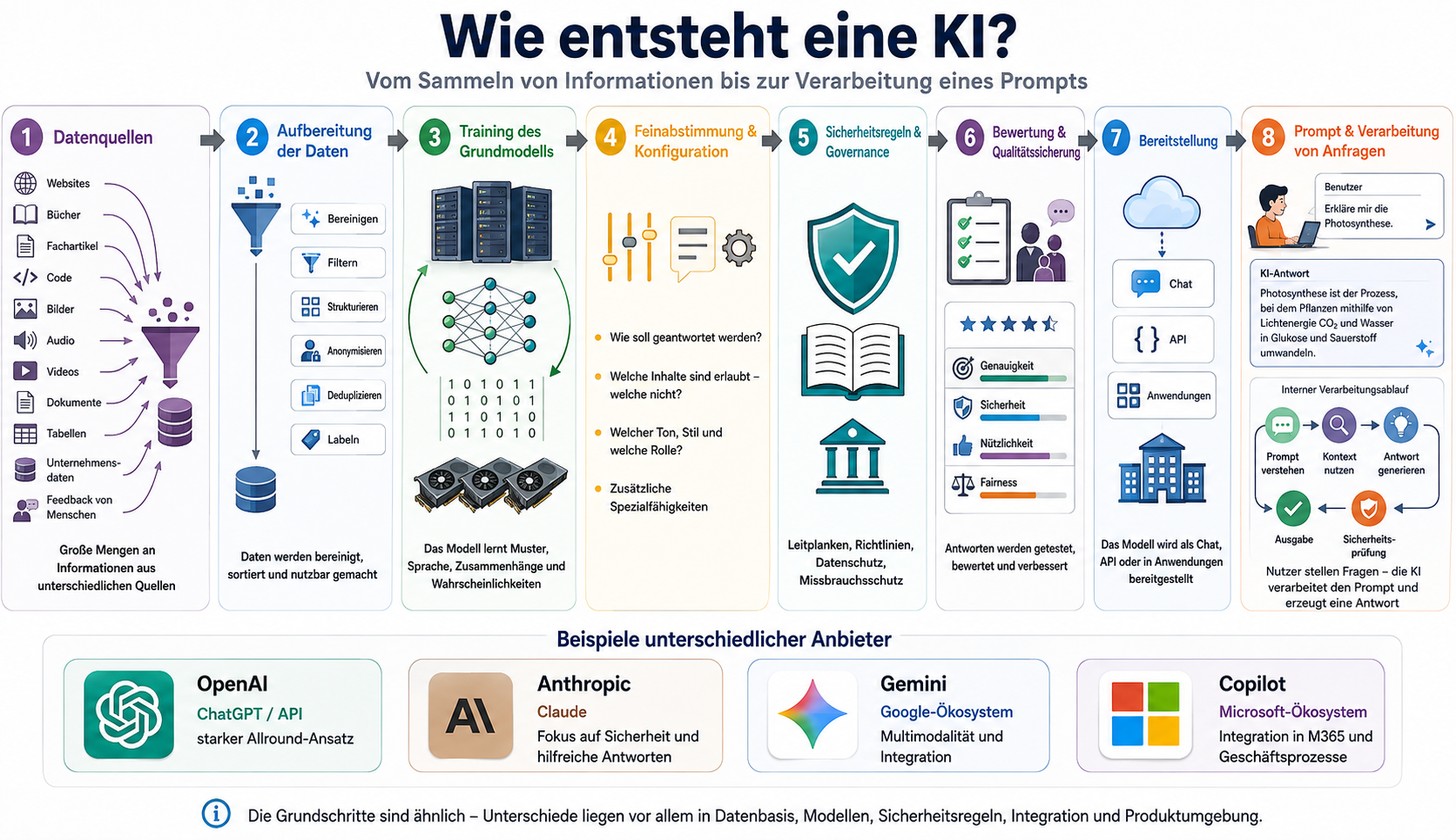
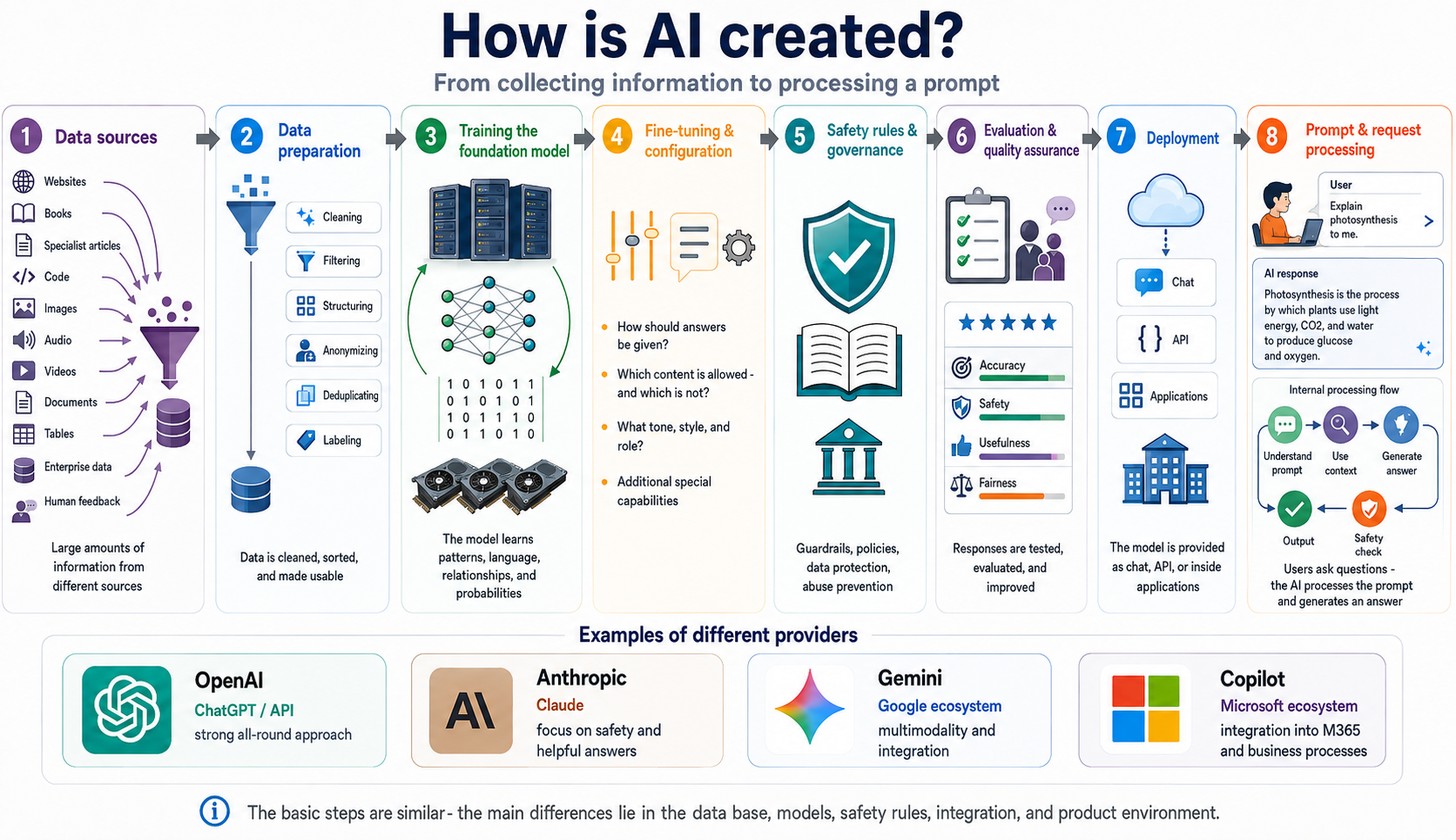
Anyone who chats with an AI like Claude or ChatGPT today sooner or later wonders: what actually happens when I ask a question? I asked myself that same question — and went straight to the source for answers. Here they are, in plain language.
Not Looking Things Up, But Predicting Them
The biggest misconception, right up front: an AI like Claude doesn't have a database it looks answers up in. Instead, it was trained to predict the next word in a piece of text — based on the enormous amounts of text it was trained on.
That sounds simple, but it has a remarkable effect: when an AI gets really good at predicting what makes sense to come next, something emerges that looks like understanding and knowledge — even though, at its core, "just" a very refined form of pattern recognition is at work.
The answer isn't "fully thought out in advance," but generated word by word (more precisely: piece of text by piece of text), with each new word depending on everything said so far in the conversation.
Why an AI Doesn't Simply Know What Time It Is
A simple example illustrates the limits well: if you ask an AI for the current time, it can't just "know" that. It has no internal clock and doesn't keep "thinking" between two conversations — it essentially only exists in the moment it generates an answer.
There are three different ways an AI gets hold of information, and telling them apart helps enormously with understanding:
Trained knowledge – what was learned from vast amounts of text during training. This knowledge has a fixed knowledge cutoff¹ and isn't updated after that point.
Provided context – information automatically supplied to an AI at the start of a conversation, such as today's date or the chat history so far. This applies solely to that particular conversation — there's no real-time exchange with other users.
Actively retrieved information – when the AI, for example, runs a web search to fetch current information, much the way a human would do on Google.
For anything that happened between the training cutoff and today, the AI simply knows nothing — unless it actively searches for it.
Where Does the Trained Knowledge Actually Come From?
This is where it gets interesting — and at times uncomfortable. The training data of large AI models comes from a vast mix of text: websites, articles, code, and yes, books too.
Books in particular show just how elaborate, and at times controversial, this data acquisition was. It became publicly known, for example, that Anthropic (the company behind Claude) bought millions of printed books to digitize them: in a process known as destructive scanning², the spines were mechanically cut off, each page was scanned, and the paper was then discarded. A US court later ruled that this buy-and-scan process was legally permissible, since the books had been acquired legally.
Another part of the story was apparently less clean-cut: there are indications that, at least for a time, digital books from questionable, unlicensed sources were also used. That led to a class-action lawsuit by authors, which has since been settled for a payment in the billions.
As for the origin of academic papers, which are often behind paywalls, there's no fully publicly documented information — a point where, in all honesty, even the AI itself can't give a reliable answer.
Was the AI Told How to Interpret Texts?
One important distinction: training happens in two very different phases.
Phase 1 – pure training: here, there were no content-related instructions at all, such as "this book is especially trustworthy" or "you should be skeptical of this text." The model learned in a purely statistical way which sequences of words are likely in which contexts — without anyone rating or classifying individual content.
Phase 2 – fine-tuning³ after training: only afterward do targeted human instructions come into play. Humans rate different AI responses and give feedback on which ones are more helpful, honest, or appropriate. In addition, some companies work with a set of values and behavioral guidelines the AI is meant to follow.
Important to note: this steering affects how the AI answers and behaves — not how a particular book or academic article should be assessed in terms of content. In other words, there was no authority during training that reviewed and weighted individual knowledge sources on their merits.
And What About Claude, ChatGPT, Copilot, and Gemini — Isn't That All the Same Thing?
At first glance, all AI chatbots look similar: you type a question, you get an answer. But under the hood, there are real differences — even though the basic principle (predicting the next word, training in two phases) is comparable across all of them.
Different companies, different models: Claude is developed by Anthropic and trained entirely independently. ChatGPT comes from OpenAI and is likewise an independently developed model. Microsoft Copilot, by contrast, isn't an independent model at all — it draws on OpenAI's models. At its core, Copilot is a deep integration of OpenAI's technology into the Microsoft world (Word, Excel, Outlook, Teams). Gemini is developed by Google and is tightly interwoven with Google Workspace (Gmail, Docs, Sheets). That means: even if you use four different "assistants," underneath there are essentially only three independently trained model families — Copilot is fundamentally a wrapper around an OpenAI model, not a fourth model of its own.
Different training data and cutoffs: each company gathers its own training data, with its own contracts, filters, and quality criteria — the exact composition isn't fully public for any provider. The knowledge cutoff also varies by model and version, and is regularly updated with new model releases.
Different philosophies on fine-tuning: this is where the most interesting differences show up. For Claude, Anthropic additionally relies on an approach called "Constitutional AI⁴" — the model is guided by a written set of values and is trained to admit uncertainty rather than guess. OpenAI and Google pursue similar goals (helpful, safe answers) with their own methods, but they weigh factors like creativity, caution, and speed differently.
Different access to current information: thanks to its tight connection to Google Search, Gemini often has very direct access to current events. Copilot uses Bing Search for current information. Claude and ChatGPT also actively draw on a web search when needed, but do so selectively for individual questions rather than automatically searching on every request.
Different everyday strengths: in practice, it's often reported that Claude is seen as especially strong with long documents, careful text analysis, and code. ChatGPT scores with great versatility and a broad feature set. Copilot plays to its strengths where work happens directly with a company's own data inside Microsoft programs. Gemini benefits strongly from its integration into Google products and Google Search.
In the end, all four systems are built on the same basic principle described in this article — but each company makes its own decisions on training data, fine-tuning, and connections to other tools. In practice, that leads to noticeably different behavior, even though the technical foundation is similar.
What This Means for Everyday Life
The practical consequence of all this: an AI's "knowledge" on a given subject isn't expert-curated textbook knowledge, but the result of what appeared frequently in the training data, and in what form. That also explains why AI systems hit their limits with current, fast-changing, or highly specific technical questions — tax or customs law, for instance — and why, when in doubt, you should bring in current sources or experts as well.
AI often comes across as remarkably competent — and in many areas, it is. But knowing how that knowledge came to be helps put it in the right context: as a statistically learned pattern from a vast, not perfectly curated collection of text — not as a fact-checked encyclopedia.
Glossary
¹ Knowledge cutoff – The point in time up to which an AI model's training data extends. The model knows nothing about events after this date unless it actively fetches current information, e.g. via a web search.
² Destructive scanning – A digitization process in which printed books are mechanically taken apart (spines cut off, pages scanned individually) to convert them into machine-readable text at scale. The physical book is destroyed in the process.
³ Fine-tuning – An additional training step that follows the core pre-training. Humans rate the model's responses, and the model is trained to produce more of the responses that were rated positively.
⁴ Constitutional AI – A training approach developed by Anthropic in which a model is additionally guided by a written set of values and behavioral guidelines, rather than being steered exclusively through human feedback.