I've always wondered: what was the very first moment when something was actually achieved with artificial intelligence — not just a thought experiment on paper, but a program that ran on a real machine and solved a real problem? While researching this, I found an answer, and the time when it happened surprised me quite a bit: we're not talking about the 2010s here, but the early 1950s — years before the term "artificial intelligence" had even been coined.
Almost simultaneously, two completely different answers emerged to the same underlying question: how do you actually teach a machine to behave intelligently? One answer was called learning through experience, the other imitating human thinking. Both approaches still shape how we think about AI today — even though hardly anyone knows their actual origins. I'd like to introduce them to you in a bit more detail.
Learning Through Experience – Arthur Samuel, from 1952
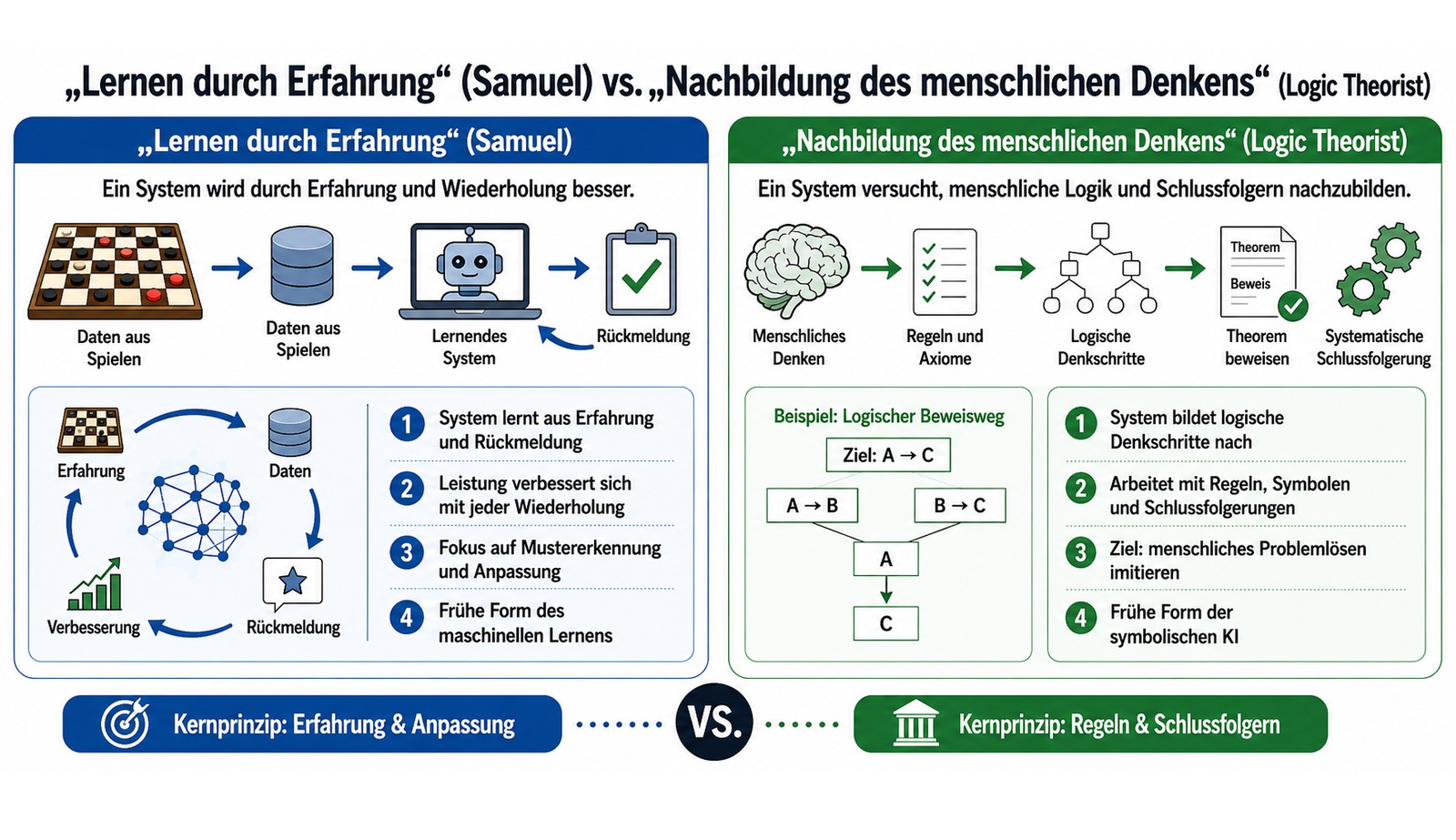
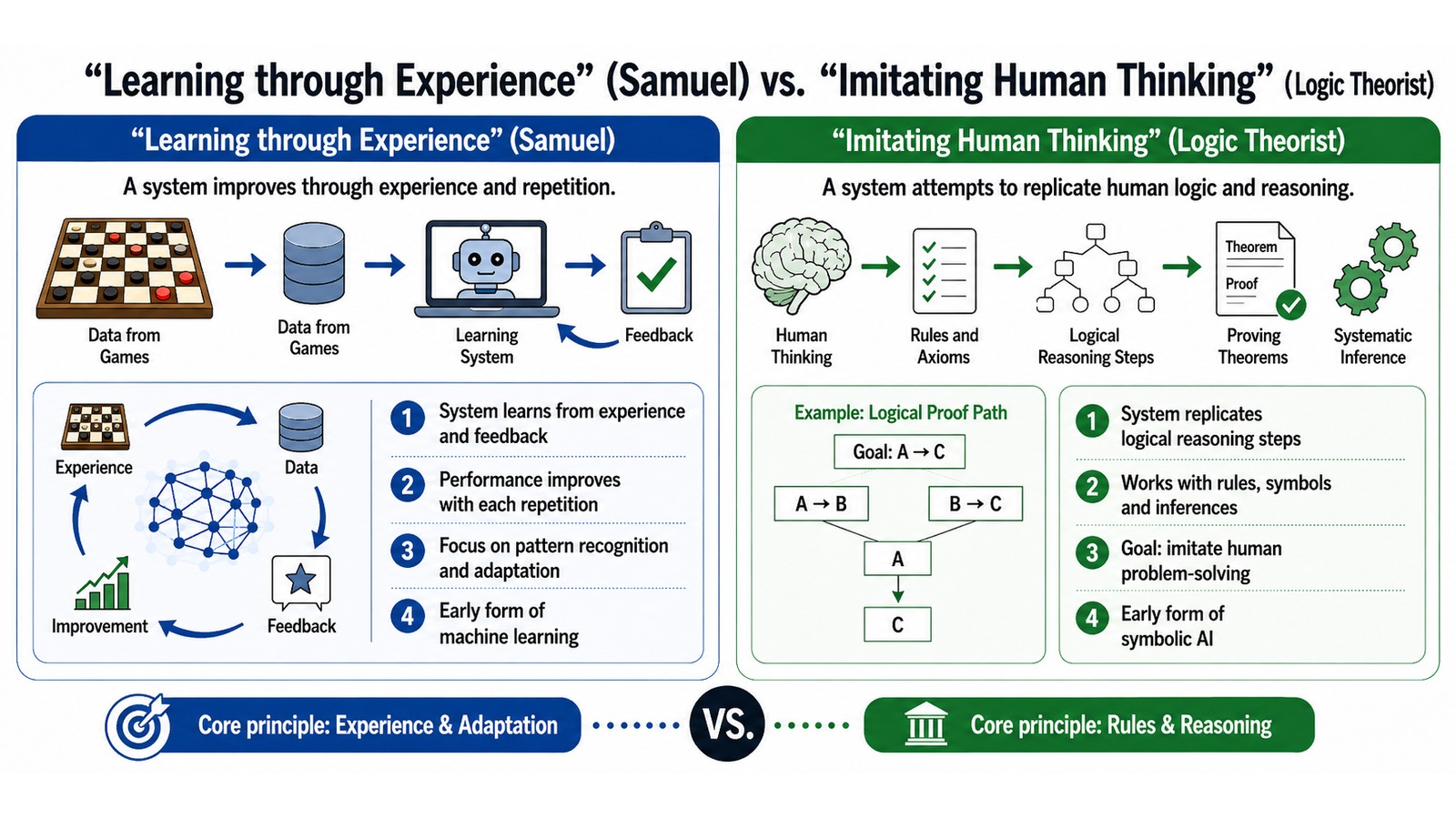
Arthur Samuel, an electrical engineer at IBM, chose a task for his experiment that looks simple at first glance: checkers. The game was complex enough to be a genuine challenge, yet simple enough to actually compute on one of the very first commercial mainframe computers¹ — first the IBM 701, later the more powerful IBM 704, each with just a few kilobytes of memory.
His program evaluated possible moves using a scoring formula that weighed different factors of the board position against each other — things like material advantage or how well the center of the board was controlled. The real innovation came in 1955: Samuel had the program play thousands of games against itself, and after every game it automatically readjusted how heavily each factor should count toward the score — depending on whether a given strategy had ultimately led to a win or a loss. No human had to type in a single new rule; the program improved purely by repeatedly playing and evaluating its own performance.
In 1956, the program was even demonstrated on American television — for many viewers, their very first encounter with a seemingly "thinking" machine. Finally, in 1962, it won a game against a former checkers champion from Connecticut, proving that a self-learning system could genuinely hold its own against a human expert. Around this time, Samuel also coined the term we still use every day, often without a thought for its origin: machine learning².
Imitating Human Thinking – Newell, Simon & Shaw, 1955/56
A far more ambitious goal was pursued by Allen Newell, Herbert Simon (later a Nobel laureate in economics), and programmer Cliff Shaw at the RAND Corporation. They didn't just want to solve a single task — they wanted to replicate how humans reason and solve problems in the first place. Their program, the Logic Theorist³, was given a foundation of formal logic rules and axioms, and was meant to find complete mathematical proofs entirely on its own — by systematically working backward from the goal to already-known principles, rather than blindly trying every conceivable combination.
Before the program ever ran on a computer, the team tested its logic by hand: family members literally acted out individual memory cells, moving index cards with symbols on them to simulate the process — long before it was actually programmed on the RAND Corporation's JOHNNIAC computer. For this, Newell, Simon, and Shaw even developed their own programming language, IPL⁴ — an early precursor of what would later become Lisp, the language that shaped AI research for decades.
As a test bed, they chose "Principia Mathematica"⁵ by Whitehead and Russell, one of the most demanding works in modern mathematics. The Logic Theorist independently proved 38 of the first 52 theorems⁶ from the second chapter — and in at least one case even found a more elegant proof than the human original authors. Simon later actually sent that proof to Bertrand Russell himself, who reportedly found it highly amusing.
When the program was presented in the summer of 1956 at the famous Dartmouth Conference⁷ — the very place where the term "artificial intelligence" was coined — it was the only system in the room that actually ran. Every other participant brought only concepts and ideas.
Two Paths, One Question
Roughly 70 years now separate us from these first attempts — a span of time in which you'd have expected to find AI in science-fiction films rather than in everyday life. Neither original program is still running today, but their underlying ideas have proven remarkably durable. Samuel's approach — learning from experience, automatically improving a strategy based on data and feedback — is, at its core, what today runs under the banner of deep learning and machine learning, from image recognition to the very language models that helped write this article. The Logic Theorist, meanwhile, stands at the beginning of what's known as symbolic AI, where knowledge is represented as explicit rules and logic — an approach that saw another major boom in the 1980s with expert systems.
For a long time, the two camps were seen as near-opposites, almost like two competing schools of thought. Only in recent years has it become clear that modern AI systems increasingly combine elements of both worlds: learning-capable systems that are additionally equipped with explicit rules or tools.
Which of the two approaches would you call "real" AI — learning through experience, or imitating human thinking? There's still no clear-cut answer today, and that's exactly what makes the question so interesting.
Glossary: Key Terms Explained Simply
¹ Mainframe Computer – A very large, powerful computer from the early days of computing that typically filled an entire room and was used by companies or universities for computation-heavy tasks.
² Machine Learning – The umbrella term for methods in which a computer isn't programmed with fixed rules but instead learns independently from experience or example data, automatically improving its strategy.
³ Logic Theorist – A computer program developed in 1955/56 that was among the very first to attempt proving mathematical theorems on its own using formal logic rules. Widely considered one of the first true AI programs in history.
⁴ IPL (Information Processing Language) – A programming language developed by Newell, Simon, and Shaw in the 1950s for processing lists and symbols. Considered a precursor to Lisp, which went on to be the most important programming language in AI research for decades.
⁵ Principia Mathematica – A three-volume foundational work of mathematics by Alfred North Whitehead and Bertrand Russell (1910–1913), which attempts to build the whole of mathematics on strictly logical rules.
⁶ Theorem – A mathematical statement whose truth must be established through a logical proof before it can be considered certain.
⁷ Dartmouth Conference – A workshop held at Dartmouth College in the summer of 1956, where the term "artificial intelligence" was coined for the first time. Widely regarded as the official birth of AI research as its own field.