When people think of “AI in everyday life,” they often picture futuristic scenarios — robots, self-driving cars, the big revolution. But the real revolution is playing out much more quietly: in millions of small, unobtrusive moments where people simply ask a question, get a text suggestion, or quickly look up instructions.
So the interesting question isn't “is AI coming into our everyday life?” — it's already here. The question is: what are we actually using it for?
The Factual Anchor: What We Know About ChatGPT
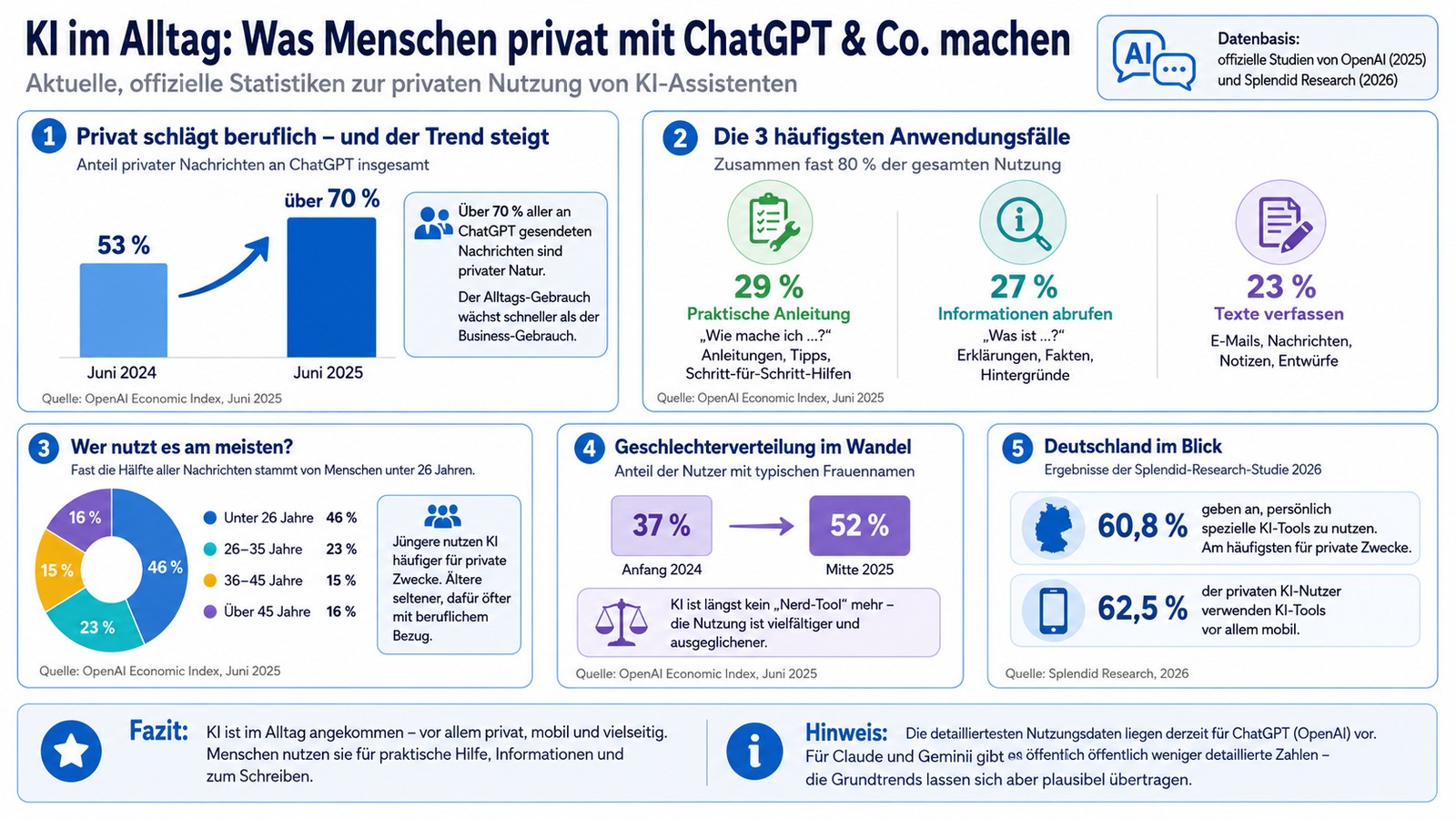
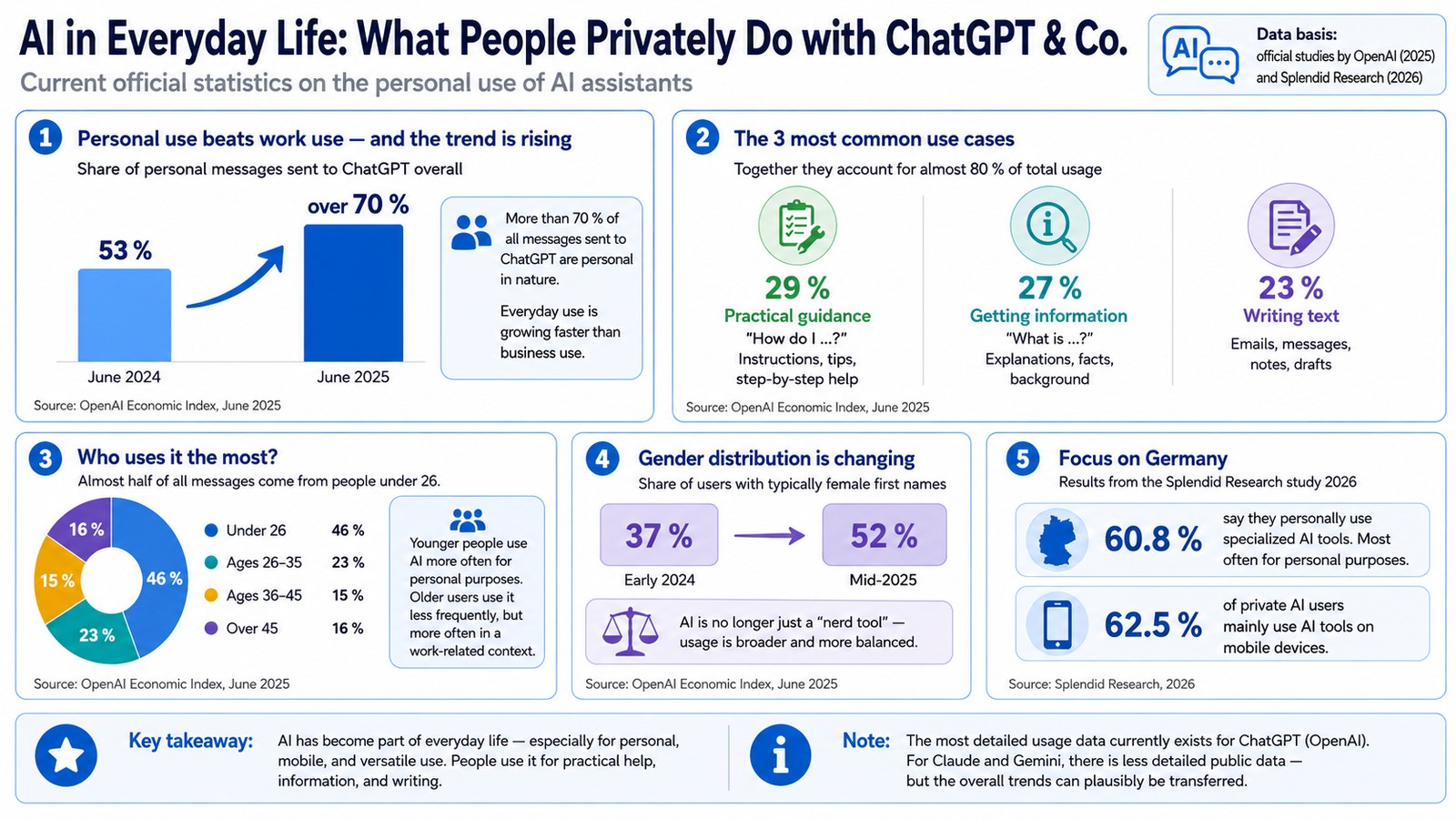
For ChatGPT, this can now be answered with hard numbers, because OpenAI itself published a major study on its own usage for the first time in 2025 — based on an analysis of millions of anonymized chats. The result is surprising: personal use clearly beats work use. The share of personal messages rose from 53 percent in June 2024 to over 70 percent in June 2025.
The three most common needs — practical guidance (29%), getting information (27%), and writing text (23%) — together make up almost 80 percent of total usage. No coding, no data analysis, no world revolution. Instead: “How do I...,” “What is...,” “Draft me a...”
Who is asking these questions has also shifted: almost half of all messages come from people under 26, and the share of female users rose from 37 percent (early 2024) to 52 percent (mid-2025). AI is no longer a “nerd tool” — usage has become broader and more balanced. Germany has a fitting figure too: according to Splendid Research (2026), 60.8 percent of respondents personally use AI tools, most often for personal purposes — 62.5 percent of them mainly on mobile devices.
And Gemini? An Educated Guess Instead of a Number
For Google Gemini, there's no comparable study. Google publishes growth figures — over 900 million monthly active users — but no breakdown like ChatGPT's. That invites speculation, but an educated kind.
One key structural difference: choosing ChatGPT is a deliberate act. You have to download the app, sign in, actively opt in to the tool. Gemini, by contrast, is right there on most Android smartphones from day one — pre-installed, with no sign-in hurdle, often embedded directly in Google Search. This frictionlessness suggests that the share of casual, personal use is likely even higher for Gemini than for ChatGPT — simply because the barrier to entry is close to zero.
That's not proven. But it's the most plausible explanation for a pattern that other studies hint at too: AI almost always arrives in our personal lives first, before it arrives at work.
And Claude? A Different Usage Pattern
A third perspective is worth a look, because it doesn't confirm the picture so far — it breaks it: Anthropic has published its own usage data for Claude, and it shows a different distribution. Instead of everyday questions and text drafts, computer and coding tasks dominate here — roughly a third of all requests — followed by education-related topics and office work.
Session length fits the picture too: at around 18 minutes per session, it's longer than any other AI chatbot — a sign of deeper, more complex work rather than quick, in-between questions. Based on the available figures, Claude is used noticeably less often for small everyday moments and more often for focused, specialized tasks — frequently in a professional or technical context.
The most precise numbers exist wherever someone publishes them — not necessarily where usage is highest. For Gemini, what's missing isn't the usage, it's the transparency.
Conclusion
What does that mean for you in everyday life? You're probably already using AI more often than you think — not for the big things, but for the small ones: a quick question, a text suggestion, a set of instructions. For ChatGPT, that's now documented. For Gemini, much suggests it's similar or even more pronounced — just without official confirmation. Claude, in turn, shows something else: not every AI is used the same way — some find their place in focused work rather than casual everyday moments.
In the end, what matters less is exactly which tool you use, and more the insight behind it: AI in everyday life is long since the rule, not the exception — just not in the same way everywhere.