When we talk to Gemini today, work with ChatGPT, or have Claude help with writing, it all feels like an invention of the last three or four years — triggered by the ChatGPT moment in late 2022. But while researching the history behind these tools, I found something different: the real story doesn't begin in 2022, but a full decade earlier — and a single company assembled the puzzle pieces so systematically that it raises the question of whether it was actually the true engine behind the whole development. That company is Google.
To answer this question properly, you have to separate four distinct phases: the origin in five completely different topic areas, the years-long collection phase happening quietly behind the scenes, the surprisingly late fusion into a single organization — and finally Gemini, the visible result of it all. And at the end, it's worth taking a look at something that makes the story truly interesting: Google's own shopping spree is exactly what gave rise to its strongest competitors.
🧩 The Origin: Five Puzzle Pieces Starting in 2012
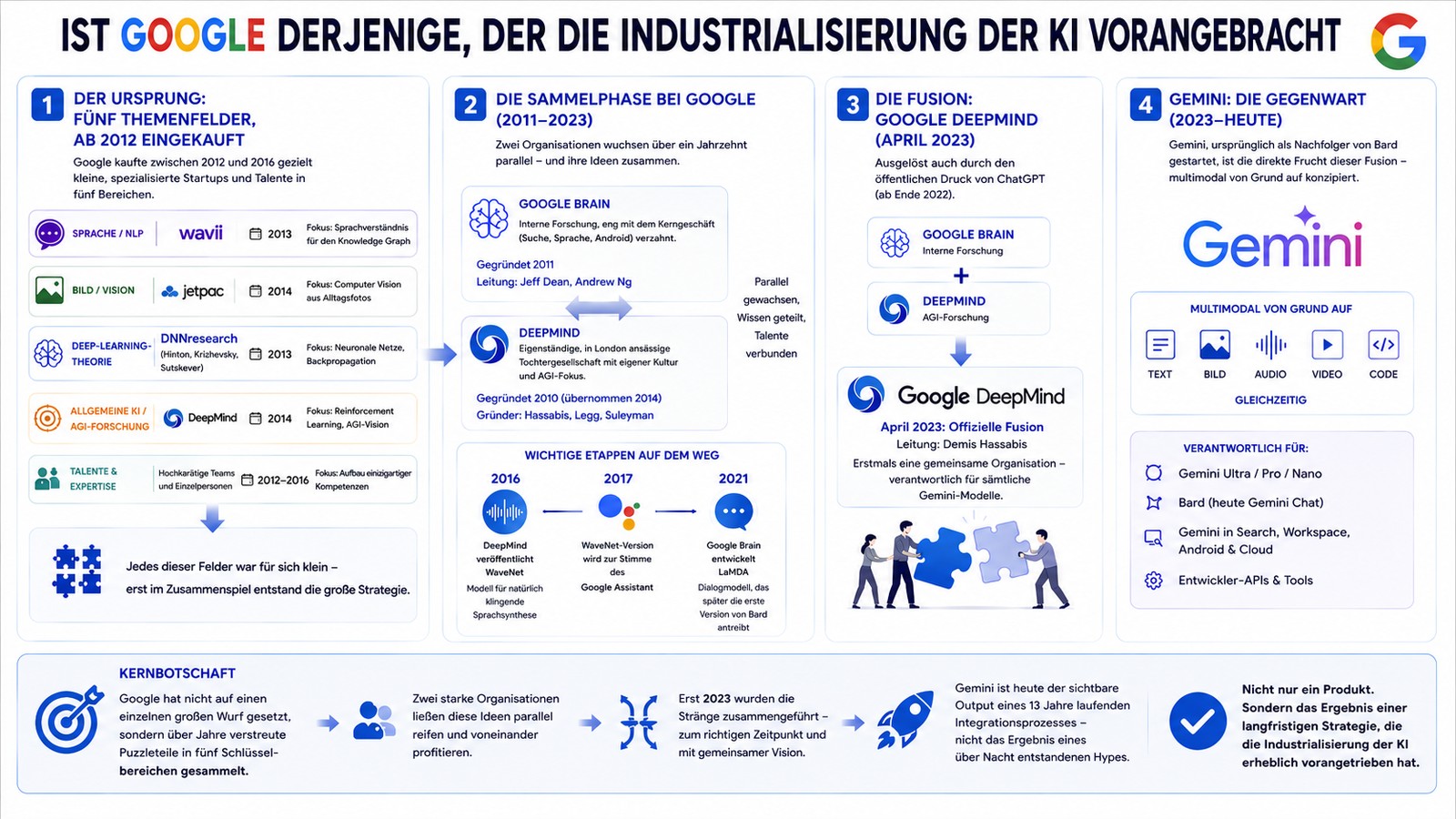
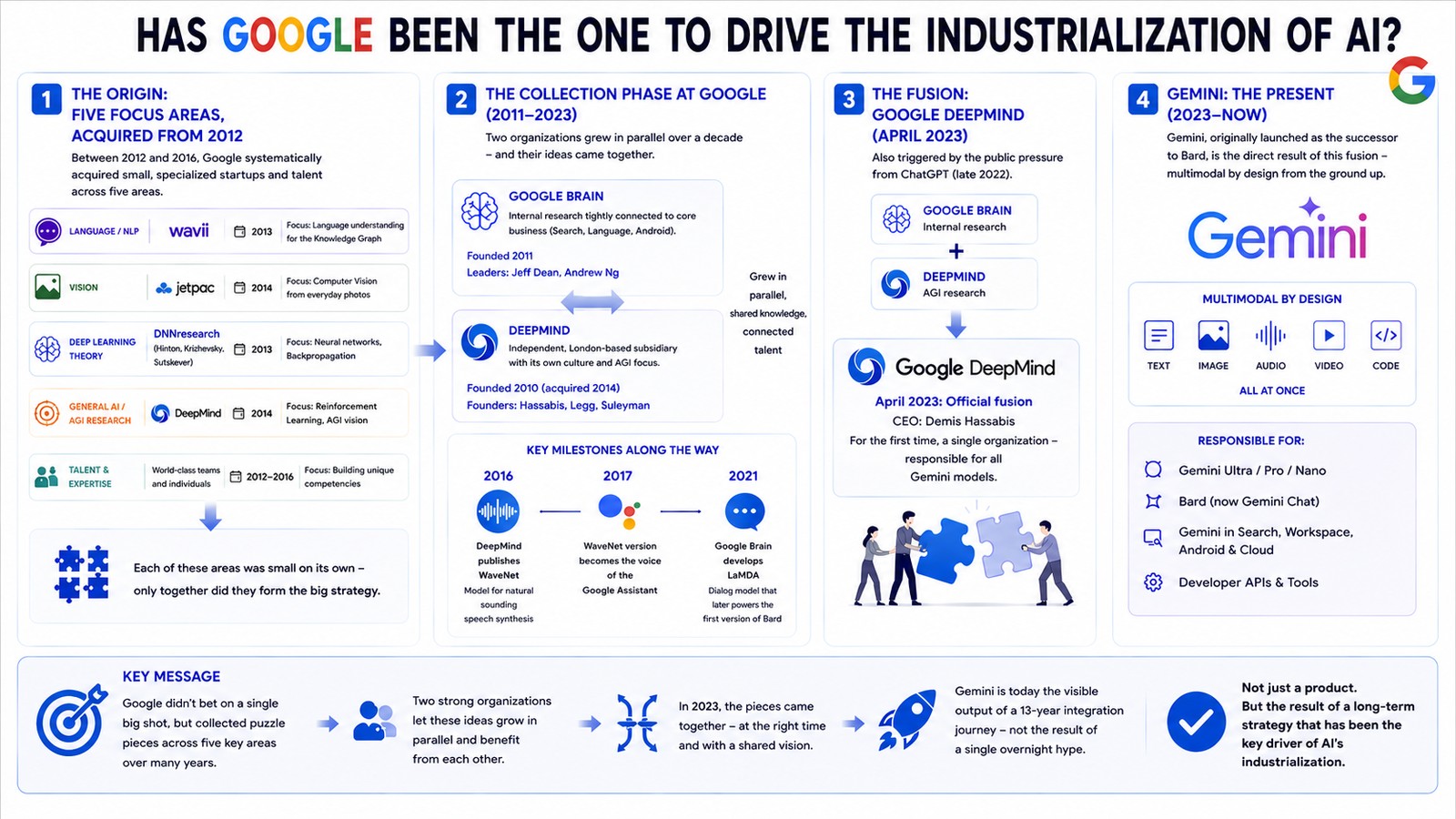
Between 2012 and 2016, Google systematically acquired small, highly specialized startups and research teams across five completely different areas — none of them a major project on its own, but together they added up to a strategy.
In the language field, Google acquired the Seattle startup Wavii in 2013, which used natural language processing to automatically summarize news and text — technology that flowed directly into Google's Knowledge Graph. In the field of image understanding, Jetpac joined in 2014, a startup that automatically generated travel guides from public Instagram photos — an early, almost quirky example of applied computer vision.
The robotics area was on a much larger scale: within just a few months in 2013, Google bought eight robotics companies in one go, including the best-known name in the field, Boston Dynamics. The division was internally called "Replicant" — a nod to the artificial humans from "Blade Runner" — and was led by Android founder Andy Rubin. The project largely failed within a few years, as we'll see shortly, but it was a clear signal: from the very beginning, Google thought of AI not just as software, but as physical technology too.
The actual scientific foundation came from a fourth area, deep learning¹ theory: in 2013, Google acquired DNNresearch, the small company founded by Toronto professor Geoffrey Hinton and his two students Alex Krizhevsky and Ilya Sutskever. Hinton had spent decades working on neural networks and so-called backpropagation — the method by which a neural network learns from its own errors. Shortly before, his team had shown with AlexNet that this theory was genuinely practical, beating every other approach in a well-known image recognition competition by more than 40 percent.
The final piece came in 2014 with what remains the best-known acquisition to this day: DeepMind, founded by Demis Hassabis, Shane Legg, and Mustafa Suleyman with the stated goal of "solving intelligence" — in other words, building a general, human-like AI, a so-called AGI². Unlike the other acquisitions, DeepMind specialized from the outset in reinforcement learning³ — a system learning through trial and reward, as AlphaGo later did with the board game Go.
Each of these five fields was small and unremarkable on its own. Only together did they form a major strategy — and that's exactly what makes the question about Google's role so interesting: no single acquisition was revolutionary, but the sum of all five was.
🏗️ The Collection Phase at Google (2011–2023)
What surprises many people: these five acquisitions weren't immediately merged into a single product. Instead, two parallel organizations grew alongside each other for more than a decade without being organizationally combined.
On one side stood Google Brain, founded in 2011 by Jeff Dean and Andrew Ng — tightly interwoven with the core business, embedded directly in Search, language, and Android. On the other side stood DeepMind: an independent, London-based subsidiary with its own culture, its own AGI-focused research agenda, and deliberately kept at arm's length from Google's day-to-day business.
That this separate structure still bore fruit is shown by a few milestones from this era: in 2016, DeepMind published WaveNet, a model for natural-sounding speech synthesis; just a year later, a version of it became the voice of the Google Assistant. In 2021, Google Brain developed LaMDA, a dialogue model that later powered the first version of Bard — Google's first, still hesitant attempt to bring a chatbot to the public.
So this dual structure was by no means unproductive — but it also shows how cautiously Google acted despite its early head start. Two strong organizations let their ideas mature in parallel over years and exchanged knowledge and talent, without that turning into a shared, externally visible flagship product. That was only going to change under outside pressure.
🔗 The Fusion: Google DeepMind (April 2023)
The decisive push didn't come from within, but from outside: when OpenAI released ChatGPT in late November 2022, it triggered what was widely reported inside Google as a "code red" — the first real public proof that a competitor could win millions of users within a few weeks with a single product, while Google had kept its own AI technology largely in the background for years.
The response followed in April 2023: Google Brain and DeepMind were officially merged into a single organization, Google DeepMind, led by Demis Hassabis. For the first time in the more than decade-long history of these two originating organizations, there was now a shared structure responsible for all Gemini models. What had grown in parallel for a decade was brought together within a few months — at exactly the right moment and with a shared vision, as the trade press put it at the time.
✨ Gemini: The Present (2023–Now)
Gemini, originally launched as the direct successor to Bard, is the visible result of this fusion — designed from the ground up to be multimodal⁴, able to process text, image, audio, video, and code simultaneously rather than being trained on text alone, as earlier chatbots were. Today, Google DeepMind is responsible for the entire model family (Ultra, Pro, Nano), for Bard as today's Gemini Chat, for integrating Gemini into Search, Workspace, and Android, and for the developer APIs and tools.
One thing I find especially remarkable, because it shows that nothing really gets lost in this ecosystem: the robotics adventure of 2013, which seemed to have failed for good when Boston Dynamics was sold in 2017, is alive again in an entirely new form. Just a few days ago, in late July 2026, Google DeepMind introduced "Gemini Robotics 2" — a model that gives robots whole-body control, dexterity, and the ability to collaborate with other robots, all directed by a kind of "high-level brain" called Gemini Robotics ER 2. The 2013 vision — Google as a robotics company — isn't dead after all; it's simply returning on the back of language models instead of acquired hardware companies.
🌱 But Was Google Really the Only Driver?
This is where the story gets truly interesting — because Google's aggressive shopping spree had a side effect that ultimately cost the company part of its lead. When Google won the bid for DeepMind in 2014, Facebook had also been bidding and lost — in response, Facebook promptly founded its own research lab, Facebook AI Research (FAIR), led by the renowned Yann LeCun.
An even more consequential second bidding war unfolded around the same deal: Elon Musk had also invested in DeepMind and later claimed he tried to outbid Google — unsuccessfully. A year later, in 2015, he co-founded a new, independent lab: OpenAI. The very company whose ChatGPT would trigger Google's "code red" seven years later thus emerged directly as a reaction to a lost Google acquisition.
The chain continues further: in 2020/21, several leading OpenAI researchers, including siblings Dario and Daniela Amodei, left the company over disagreements about direction and the role of safety in AI development. They founded Anthropic — the company behind Claude, which also helped write this article.
So the original question can't be answered with a simple yes or no. Google was undoubtedly the company that, for the first time, systematically bought up the foundations of today's AI industry across five different topic areas over the course of years — without these early deals, today's industry probably wouldn't look the way it does. At the same time, it was precisely this aggressive acquisition strategy that, through lost bidding wars, gave rise to its own competition. Google didn't drive the industrialization of AI single-handedly — but without Google, there probably wouldn't be an OpenAI or an Anthropic in their current form.
What sticks with me most is this: this story isn't a straight line from a single invention to a finished product, but an ecosystem of acquisitions, lost bidding wars, and spin-offs — one in which, in the end, almost every major name in the industry is somehow connected to decisions Google made in the early 2010s.
Glossary: Key Terms Explained Simply
¹ Deep Learning – A subfield of machine learning that uses multi-layered artificial neural networks to independently recognize patterns in large amounts of data, rather than following fixed, hand-written rules.
² AGI (Artificial General Intelligence) – A hypothetical AI that doesn't just master a single task but possesses human-like, general intelligence and can be flexibly applied to entirely new problems.
³ Reinforcement Learning – A learning method in which a system learns through trial and error and a kind of reward signal which actions lead to a good outcome — similar to training an animal through rewards.
⁴ Multimodal – The ability of an AI system to process and combine different types of data — such as text, image, audio, video, and code — simultaneously, rather than being trained on just a single type of data.